
WELCOME BONUS 300%
UP TO €2000 + 100
FREE SPINS
Home → Blackjack
Blackjack at Mr Pacho Casino: Variants, Rules and Payouts
Soft vs Hard Hands in Practice
A soft hand contains an ace counted as 11, a hard hand counts that ace as 1, and this distinction drives the basic strategy figure of Blackjack 6 decks, S17, DAS, DOA, 3:2 payout, where perfect play yields an RTP of 99.54% and a house edge of 0.46%. That 0.46% means 100 € of stakes costs about 0.46 € on average across many rounds. A player who hits soft 18 against a strong dealer card instead of standing turns that 0.46% into a much larger leak.
In Blackjack Liberal Vegas Strip the liberal rule set combines S17, DAS, resplit and late surrender for an RTP of 99.72% and a house edge of 0.28%, which is 0.18 percentage points better than the 0.46% of the standard six-deck game. On a 100 € stake the difference is roughly 0.18 € per hand in expected cost. Hard totals of 12 to 16 are where beginners most often misread the soft-hand rules.
Blackjack Single deck, classic rules, 3:2 reaches an RTP of 99.85% and a house edge of 0.15%, the lowest edge among the blackjack rule sets, because one deck gives about −0.48 percentage points compared with eight decks. That single-deck advantage is frequently offset by a 6:5 payout. A beginner who treats every ace the same way loses the soft-hand benefit these figures describe.
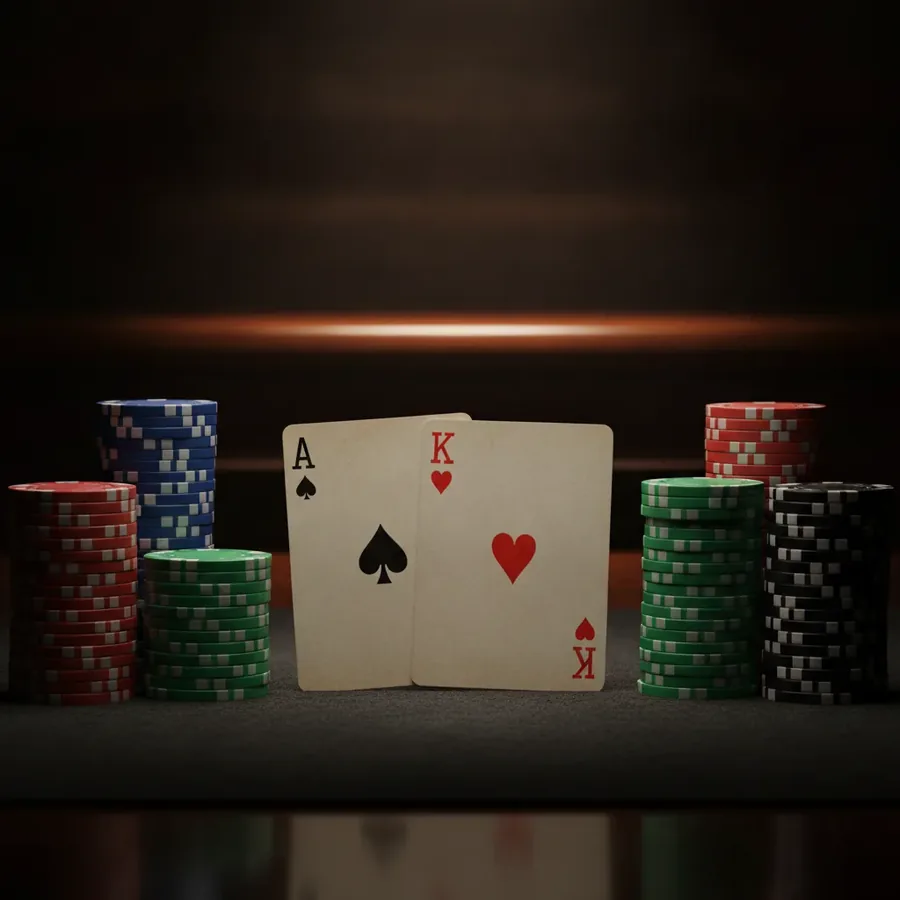
RNG Deals From a Virtual Eight-Deck Shoe
A random number generator, or RNG, produces each card from a virtual shoe, and the six-deck variant Blackjack 6:5 payout instead of 3:2 carries an RTP of 98.15% with a house edge of 1.85%. That 1.85% is exactly 1.39 percentage points higher than the 0.46% of the standard six-deck S17 game, which is more than any other single rule change adds. On a 10 € bet a blackjack pays 12 € instead of 15 €.
Under the standard six-deck rules with S17, DAS, DOA and a 3:2 payout, the RTP sits at 99.54% and the house edge at 0.46%, so a virtual shoe of six decks is measurably cheaper for the player than one paying 6:5. Across 1,000 rounds at 10 € each, that is 10,000 € of stakes and roughly 46 € of expected cost at 0.46%, against 185 € at 1.85%. The RNG shuffles between shoes, not within a round.
Insurance is a separate side bet of up to 50% of the main bet when the dealer shows an ace, and Blackjack Insurance (6–8 decks) carries an RTP of 92.53% with a house edge of 7.47%. Basic strategy always declines it, since 7.47% is far above the 0.46% of the underlying game. With a single deck the insurance edge is about 5.88%. The 2:1 payout does not compensate for that gap.
When Can You Raise Your Bet?
Doubling down allows a stake to be increased to twice its size in exchange for exactly one additional card, and under the S17, DAS, DOA rule set the house edge is 0.46% while doubling after a split improves the return by about 0.14 percentage points. A 10 € double therefore puts 20 € at risk on a single card. The increase is only permitted on the first two cards of a hand.
Splitting converts one hand into up to 4 hands, and resplitting aces improves the return by 0.08 percentage points, while doubling after a split contributes about 0.14 percentage points and six decks instead of eight adds about 0.02 percentage points. Split aces usually receive one card each, so the bet can be raised across several hands at once. A 10 € split of a pair of aces commits 20 € in total.
Late surrender lets the player give up a hand after the dealer has checked for blackjack and lose half the stake, which improves the return by about 0.08 percentage points, while early surrender is worth up to −0.6 percentage points and is extremely rare. On a 20 € hand, surrender returns 10 €.
Soft 17 Hit vs Stand: 0.22 Percent
When the dealer hits soft 17, the house edge rises by 0.22 percentage points, which is why the S17 six-deck game with DAS, DOA and a 3:2 payout lands at 0.46% while the H17 version of the same rules sits at roughly 0.68%. That 0.22 percentage points is more than the 0.14 percentage points gained from doubling after a split or the 0.08 percentage points from resplitting aces. On 100 € of stakes the difference is about 0.22 € per cycle.
Blackjack Liberal Vegas Strip uses S17 together with DAS, resplit and late surrender to reach an RTP of 99.72% and a house edge of 0.28%, and its standard deviation is 1.15. That 0.28% is 0.18 percentage points below the 0.46% of the S17 six-deck baseline without surrender. The comparison shows how a single dealer rule interacts with the rest of the rule set.
Blackjack Single deck, classic rules, 3:2 reaches an RTP of 99.85% and a house edge of 0.15%, and one deck gives about −0.48 percentage points compared with eight decks, a swing far larger than the 0.22 percentage points tied to the soft 17 rule. The single-deck edge is often offset by a 6:5 payout. A player comparing rules should weigh the 0.22 percentage points against the deck count.
What a Natural Blackjack Actually Pays
A natural blackjack paid at 3:2 returns 150 € on a 100 € stake, while the 6:5 version of Blackjack 6:5 payout instead of 3:2 returns only 120 €, and that single change adds exactly 1.39 percentage points to the casino's edge. The 6:5 game carries an RTP of 98.15% and a house edge of 1.85%. On a 10 € bet the blackjack pays 12 € instead of 15 €.
Under the standard six-deck S17, DAS, DOA, 3:2 rule set the RTP is 99.54% and the house edge is 0.46%, so a 3:2 natural fits a game whose expected cost per 100 € is roughly 0.46 €. Blackjack Liberal Vegas Strip pays 3:2 as well and reaches an RTP of 99.72% with a house edge of 0.28%. The 3:2 payout is the common thread between the two rule sets.
In Blackjack Single deck, classic rules, 3:2 the RTP is 99.85% and the house edge is 0.15%, the lowest figure among the blackjack rule sets, though the one-deck advantage of about −0.48 percentage points is often offset by a 6:5 payout. Insurance pays 2:1 but lowers the return in the long run, since Blackjack Insurance (6–8 decks) carries an RTP of 92.53%. A 3:2 natural is therefore worth protecting by declining insurance.
Blackjack variants at a glance
| Variant | Payout | House edge | Rule | RTP |
|---|---|---|---|---|
| Blackjack 6:5 payout instead of 3:2 (6 decks) | Blackjack 6:5, win 1:1 | 1.85% | Replacing 3:2 with 6:5 adds exactly +1.39 percentage points to the casino's edge – more than any other rule change. On a €10 bet a blackjack pays €12 instead of €15. | 98.15% |
| Blackjack 6 decks, S17, DAS, DOA, 3:2 payout, basic strategy | Blackjack 3:2, regular win 1:1, insurance 2:1 | 0.46% | Dealer stands on soft 17; double down on any first two cards; doubling after a split allowed; no surrender. Basic strategy is required to reach this figure | 99.54% |
| Blackjack Insurance (6–8 decks) | Insurance 2:1 | 7.47% | Separate side bet of up to 50% of the main bet when the dealer shows an ace. Basic strategy ALWAYS declines it (except for card counters at a true count ≥ +3). With a single deck the edge is ≈ 5.88% | 92.53% |
| Blackjack Surrender (late surrender) – rule effect | 50% of the stake returned | −0.08 percentage points | The player gives up the hand after the dealer has checked for blackjack and loses half the stake. Improves RTP by about 0.08 percentage points. Early surrender is worth much more (up to −0.6 percentage points) but is extremely rare. | n/a (rule modifier) |
| Blackjack Liberal Vegas Strip (liberal rules, 3:2) | Blackjack 3:2, win 1:1 | 0.28% | The most player-friendly rule set: S17 + DAS + resplit + late surrender. Standard deviation 1.15 | 99.72% |
| Blackjack Split / double / H17 – rule effects | Double – stake ×2 with one card; split – up to 4 hands; split aces usually get one card each. | H17 +0.22 percentage points; RSA −0.08 percentage points; DAS −0.14 percentage points | Dealer hitting soft 17 lowers RTP by 0.22 percentage points; resplitting aces improves it by 0.08 percentage points; doubling after a split improves it by about 0.14 percentage points; 6 decks instead of 8 – about 0.02 percentage points. | n/a (rule modifiers) |
Double Down or Just Hit on 11
Doubling down on 11 turns the stake into twice its size with one card drawn, and it is the play that lifts the return of Blackjack 6 decks, S17, DAS, DOA, 3:2 payout to an RTP of 99.54% when basic strategy is followed, against a house edge of 0.46%. That house edge is the average share of each stake the casino keeps over a long run of hands.
Take a €10 bet: doubling pushes €20 onto the table, and a winning hand pays 1:1, so €20 of profit replaces the €10 that a simple hit would have earned. Over 100 such spots the difference between hitting and doubling is worth roughly €10 of extra expectation when the two-card total of 11 is played correctly.
The catch sits in the rule set rather than the total: doubling after a split improves the return by about 0.14 percentage points, while a dealer who hits soft 17 takes 0.22 percentage points away, so an 11 is worth far more at a table that stands on soft 17. Doubling is only the better play while the hand holds exactly two cards.
No Doubling Down on Three Cards
A hand of three cards cannot be doubled at any table described here, because the double applies only to the first two cards, and that single restriction separates the 99.54% RTP of the six-deck, stand-on-soft-17, double-after-split game from the 98.15% RTP of the same game paying 6:5 on a blackjack. The 1.39 percentage point gap between 3:2 and 6:5 is the largest single move in the whole rule set.
The effect shows up in the payout itself: on a €10 bet a blackjack pays €15 at 3:2 and only €12 at 6:5, a difference of €3 on every natural. That is why a 6:5 table cannot be repaired by good play, no matter how carefully the three-card hands are hit.
Three-card hands still matter after a split: split aces usually receive one card each, so those hands are played out without any option to double or to draw further. A player who reaches a total of 11 on three cards has to settle for a simple hit and the 1:1 win.
Ignoring the Basic Strategy Chart: 1 Percent Wasted
Blackjack 6 decks, S17, DAS, DOA, 3:2 payout carries an RTP of 99.54% and a house edge of 0.46%, but that figure is only reached when basic strategy is followed on every decision. Deviating on a few common hands moves the return back toward the 98.15% of a 6:5 table, and the cost of that drift is paid on every stake.
At 99.54% RTP, 100 € of stakes costs about 0.46 € on average; at 98.15% the same 100 € costs 1.85 €, roughly four times as much for identical cards. Over a session of 500 hands at 10 € each, that is 5,000 € of stakes and a gap of about 69.50 € between the two ways of playing.
The cheapest habits to fix are the ones the rules allow: late surrender in Blackjack Surrender returns 50% of the stake and is worth 0.08 percentage points, resplitting aces is worth 0.08 percentage points, and doubling after a split is worth about 0.14 percentage points. Insurance is the opposite case, since that side bet comes with a 7.47% house edge at six to eight decks.
Splitting at a Live Table, Step by Step
A split turns one hand into two by matching the original stake, and the tables allow up to four hands in total; at Lightning Blackjack from Evolution the range runs from 1 to 2,500 EUR, while Infinite Blackjack from Evolution and Quantum Blackjack Plus Live from Playtech each accept 1 to 5,000 EUR. The split itself is therefore a second bet of the same size as the first.
Splitting a pair of aces is the exception to plan for: those hands usually get one card each and no further draw, so a €100 split on aces puts €200 at risk for two single-card results. Doubling after a split is the more valuable option, adding about 0.14 percentage points to the return where the table permits it.
Infinite Blackjack reports 99.47% and adds four side bets, among them Any Pair and 21+3, which are separate wagers on top of the split.
Doubling After a Split: Which Tables Allow It
Doubling after a split is the rule that separates the strongest blackjack rule sets from the rest, and it is worth about 0.14 percentage points of return. Blackjack Liberal Vegas Strip combines it with standing on soft 17, resplitting and late surrender to reach an RTP of 99.72% and a house edge of 0.28%, the lowest edge among the multi-deck games described here.
The rule is not universal: Blackjack 6 decks, S17, DAS, DOA, 3:2 payout includes it and still lands at 99.54%, while a table where the dealer hits soft 17 gives back 0.22 percentage points regardless of what the split rules allow. Single deck, classic rules, 3:2 reaches 99.85% and a 0.15% edge, about 0.48 percentage points better than eight decks, but that gain is often erased by a 6:5 payout.
At the live tables the option is folded into the game rather than advertised separately, and the stakes are the same as the main bet: doubling a split hand at Infinite Blackjack means a third unit on the table, so a €50 base bet becomes €150 across the two hands. Insurance, by contrast, is capped at 50% of the main bet and pays 2:1, yet it carries a 7.47% house edge at six to eight decks.
Six to Eight Decks in the Shoe
Blackjack Liberal Vegas Strip operates with a house edge of 0.28% and an RTP of 99.72%, using the most player-friendly rule set: S17, DAS, resplit, and late surrender. The standard deviation for this variant is 1.15. Compared with the 6-deck game at 0.46% house edge, the Liberal Vegas Strip rules give back 0.18 percentage points more to the player over the long run. For every €100 staked, the average theoretical loss is €0.28 instead of €0.46.
A single-deck classic blackjack game with a 3:2 payout shows a house edge of 0.15% and an RTP of 99.85%. Moving from eight decks down to one deck reduces the casino edge by about 0.48 percentage points.
The 6-deck game with S17, DAS, DOA, and a 3:2 payout carries a house edge of 0.46% and an RTP of 99.54% when basic strategy is used. The rule effects show that six decks instead of eight improve the return by about 0.02 percentage points. On €100 of stakes, that improvement is worth roughly €0.02, while dealer hitting soft 17 adds +0.22 percentage points to the house edge, costing €0.22 per €100 staked.
Side Bets Raise the House Edge to 5%
Blackjack Insurance with 6 to 8 decks carries a house edge of 7.47% and an RTP of 92.53%. The side bet allows up to 50% of the main bet when the dealer shows an ace. Basic strategy always declines insurance, except for card counters at a true count of +3 or higher. On a €10 main bet, taking the maximum €5 insurance side bet costs an average of €0.37 per round in theoretical losses.
The 21+3 side bet appears in Infinite Blackjack by Evolution, where four side bets are offered: Any Pair, 21+3, Hot 3, and Bust It. Infinite Blackjack has an RTP of 99.47% on the main game, but side bets carry separate, higher house edges. A player staking €1 on a side bet with a 5% house edge loses €0.05 per round on average, while the main bet at 0.53% house edge loses only €0.0053.
A 6:5 payout on blackjack instead of 3:2 adds exactly +1.39 percentage points to the casino edge, creating a house edge of 1.85% and an RTP of 98.15% for a 6-deck game. That €3 difference per blackjack is larger than the combined effect of late surrender (−0.08), resplitting aces (−0.08), and doubling after a split (−0.14), which together improve the player by only 0.30 percentage points.
Surrender or Play On With 16 Against a 10
Late surrender in Blackjack Liberal Vegas Strip improves the RTP by about 0.08 percentage points and reduces the house edge to 0.28%. The player gives up the hand after the dealer has checked for blackjack and loses half the stake. On a €100 bet, surrendering returns €50 immediately. Playing out a 16 against a dealer 10 with basic strategy costs more than €50 on average, making surrender the cheaper option.
Blackjack Surrender as a rule modifier carries no standalone RTP, but it changes the house edge by −0.08 percentage points. The 6-deck game with S17, DAS, DOA, and 3:2 payout has a house edge of 0.46% without surrender. Adding late surrender lowers that to approximately 0.38%. Over 1,000 hands at €10 each, the saved amount is roughly €8 in theoretical losses.
Early surrender is worth much more than late surrender, up to −0.6 percentage points, but it is extremely rare in modern online blackjack. Late surrender returns 50% of the stake, while playing out the hand risks losing the full €10 or €100. Against a dealer 10 with a player 16, the expected loss from hitting or standing exceeds €50 on a €100 bet, so surrendering for €50 is the mathematically correct basic strategy play.
Insurance vs Even Money When You Hold Blackjack
Blackjack Insurance with 6 to 8 decks pays 2:1 but carries a house edge of 7.47% and an RTP of 92.53%. The side bet of up to 50% of the main bet is offered when the dealer shows an ace. On a €100 main bet, a €50 insurance wager returns €100 in profit if the dealer has blackjack, but basic strategy always declines it because the true odds of the dealer having a ten are worse than the 2:1 payout.
Even money on a player's own blackjack is mathematically identical to taking insurance. When a player has blackjack and the dealer shows an ace, accepting even money pays 1:1 immediately. Declining even money and playing out the hand earns 3:2 when the dealer does not have blackjack. With a 3:2 payout, a €100 blackjack pays €150, while even money pays only €100.
The single-deck classic blackjack game lowers the insurance house edge to about 5.88%, but basic strategy still declines it. Card counters take insurance only at a true count of +3 or higher. With a 6:5 payout on blackjack, a €10 bet pays €12 instead of €15, which makes even money less attractive because the 3:2 payout is already reduced. The 3:2 payout in Blackjack Liberal Vegas Strip pays €150 on a €100 stake.
Split, Double Down and Surrender by the Numbers
Doubling after a split improves the RTP by about 0.14 percentage points in Blackjack Liberal Vegas Strip, where DAS is allowed. A player doubles by placing an additional stake equal to the original bet and receives exactly one card. On a €10 bet, doubling after a split risks €20 total but improves the long-run return by €0.014 per €10 staked compared with a game without DAS.
Resplitting aces improves the RTP by about 0.08 percentage points, while dealer hitting soft 17 lowers it by 0.22 percentage points. The Liberal Vegas Strip rule set uses S17, so the dealer stands on soft 17, avoiding that penalty. Split aces usually receive one card each, and a player may split up to four hands. On a €100 total stake, H17 costs €0.22 more than S17 on average.
Late surrender reduces the house edge by 0.08 percentage points and returns 50% of the stake. Double down uses stake ×2 with one card, and split allows up to four hands. The 6-deck game with S17, DAS, DOA, and 3:2 payout reaches an RTP of 99.54% with basic strategy. Quantum Blackjack Plus Live by Playtech shows an RTP of 99.57% with optimal strategy, slightly above the 6-deck table's 99.54%.
Contact
Live - online chat
Banking









Providers












Mr Pacho Casino 2026